What Exactly Is a Domain Name? Let’s Make It Simple
A domain name is your online address, the name people type to find your website.
Examples of domain names are:
-
google.com
-
rockmybiz.com
-
mariasbakery.co.uk
Without a domain name, the internet would only understand long strings of numbers called IP addresses (something like 192.168.1.1). Clearly, nobody wants to type that into a browser.
So, back in the early days of the internet, the Domain Name System (DNS) was invented to make websites more human-friendly.
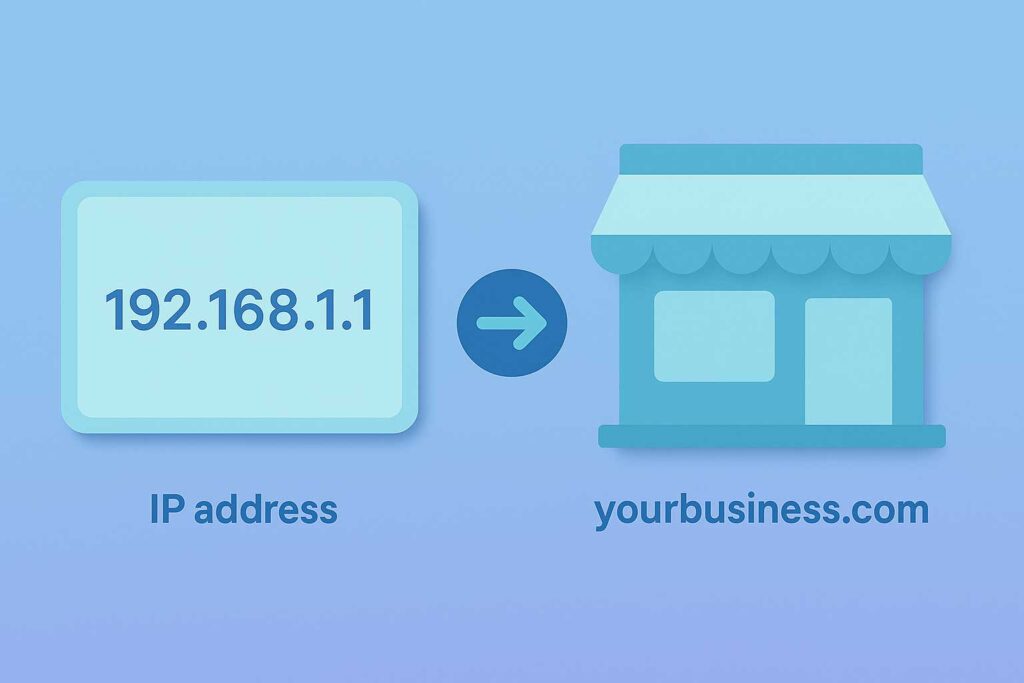
You can think of a domain name as your business’s street address, but online.
If the internet were a giant city, your domain name would be the sign above your shopfront that helps people find you quickly and easily.
A clean, simple domain makes your website feel more trustworthy and memorable from the very start.
✅ Your domain is often the first real impression someone gets of your business. Make it count!
Why Your Domain Name Matters More Than You Think
People judge your business faster online than they do in person.
Sometimes they decide in less than a second.
A good domain name helps you:
Look professional
Because nothing kills credibility faster than a poorly chosen domain like cool-cuts-4-u-265.com. A clean domain makes you look established, even if you’re just starting out.
Be easy to find
People are much more likely to remember MariaHairStudio.com than BeautyServicesLondonShopOnline954.net.
Build trust
A domain that matches your business name reduces doubt. Customers feel they’ve arrived at the right place.
Impact SEO, even slightly
Google doesn’t rank domains just because of keywords anymore, but having a clear name helps users understand what you do, which leads to better click-through rates.
How to Choose if not the Best Domain Name, a Good One!
Let’s walk through this step by step. Choosing a domain doesn’t need to be complicated, you just need a few simple rules.
1. Keep It Simple, Clear, and Easy to Spell
This is the number one rule.
If someone needs to ask you twice how to spell your domain name, it’s not a good sign.
🔸 Here’s a trick I always use with clients:
Say your domain name out loud.
If someone could write it down correctly just from hearing it, it’s good.
If they need instructions, it’s bad.
Good examples:
-
LeedsFlowers.com
-
BirminghamDentalCare.co.ul
-
GreenLeafCleaning.com
Bad examples:
-
Green-Leaf-Cleaning-Services-1234.com
-
GreeNLeaFsz.com
Short, clear, and predictable always wins.
2. Use Your Business Name When Possible
If you already have a physical store or branded business, your first choice should be:
👉 yourbusinessname.com
If that’s taken, try combining your business name with:
-
Your city
-
Your service
-
A descriptive keyword
✅ Example: If BlueWave.com is taken:
-
BlueWaveUK.com
-
BlueWaveFitness.com
-
BlueWaveWellness.co
All are excellent alternatives.
And remember: it doesn’t need to be 100% perfect, it just needs to be logical and easy to remember.
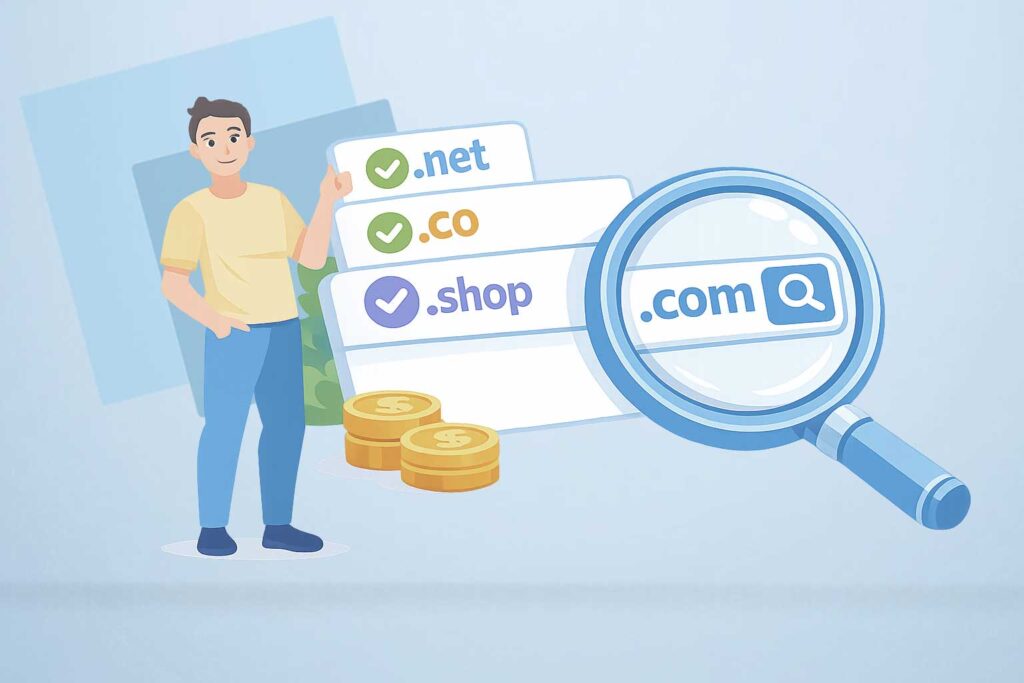
Understand Domain Extensions
The extension is the last part of a domain.
A few domain name examples include:
-
.com
-
.cu.uk
-
.co
-
.net
-
.shop
-
.studio
-
.online
Here’s how to choose the right one:
“.com” — The universal gold standard
If you can secure the .com version of your domain, it’s usually the best choice.
People around the world recognize it instantly and trust it without even thinking.
Why it’s great:
-
Works for any business
-
Easy to remember
-
Global credibility
If your .com is available, take it — even if you plan to use another extension too.
“.co.uk”, “.de”, “.fr”, “.us”, etc. — Best for local businesses
Country-specific extensions (called ccTLDs) tell visitors exactly where your business is based.
Examples:
-
.co.uk → United Kingdom
-
.de → Germany
-
.fr → France
-
.us → United States
-
.ca → Canada
These are ideal if your customers are mostly local. When someone sees a country extension, they immediately know you serve their region.
“.shop”, “.store”, “.studio”, “.online”, “.app” — Modern and creative options
If your perfect .com isn’t available — or you want something more brandable — modern extensions can help your business stand out.
These work especially well for:
-
Ecommerce stores (.shop, .store)
-
Creative businesses (.studio)
-
Online services (.online)
-
Tech products (.app)
They signal what your business does and can make your domain feel more modern.
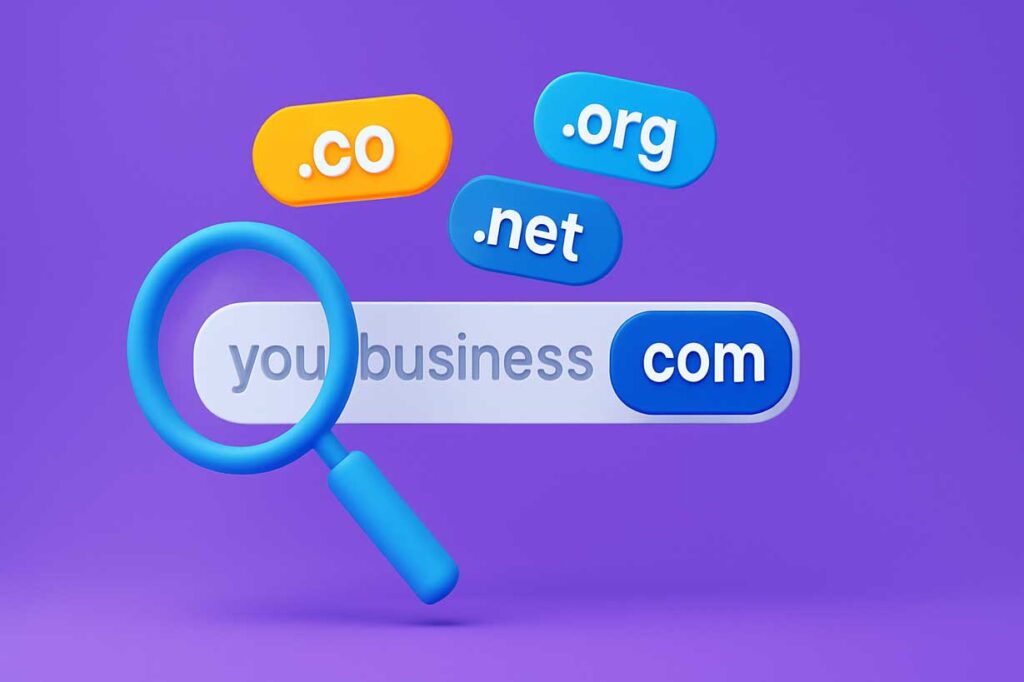
“.net”, “.org”, “.co” — Strong global alternatives
If .com is taken, these extensions are still highly trusted.
-
.net — once used mainly by tech companies, but now widely accepted
-
.org — great for nonprofits, communities, and organizations
-
.co — a modern alternative to .com, short and clean
They’re simple, recognizable, and safe choices for most businesses.
✅ And now the million-dollar question: Which domain extension should you choose?
Use this simple rule to make a decision:
-
Want global reach? → Choose .com
-
Mostly serve a specific country? → Choose your country extension (e.g., .co.uk, .de, .us)
-
Starting an online shop? → .shop or .store
-
You’re a creative or consultant? → .studio
-
Your .com is taken and you want something clean? → .co or .net
And remember:
A great brand can live on any extension — the key is choosing one that matches your business and audience.
Think for the Future
Many business owners pick a domain based only on their current situation.
But you want a name that grows with your business.
For example:
If today you’re a “Birmingham Bread Shop,” choosing
OnlyBreadBirmingham.com is limiting.
What if you expand into pastries? Catering? Additional cities?
🔸 Ask yourself:
“Will this name still fit my business in 5 years?”
If not, pick something a bit broader.
 You might also like:
 What to Do If Your Ideal Domain Is Already Taken?
If the ideal domain name for your business is taken, then choose the next best domain name that makes sense.
Here’s what works:
-
Add your city: mariasbakerylondon.com
-
Add your category: mariasbakeryuk.com
-
Try another extension: mariasbakery.co.uk
-
Add a simple word like “official” or “shop”: mariasbakeryofficial.com
-
Shorten the name slightly: mariasbake.com
There is always a clean, professional alternative, you just need 2–3 ideas to test.
Voice Search Compatibility
Most guides talk about spelling, but in 2025, people are saying domain names more than typing them.
-
The Problem: A domain like
number1plumber.comis a nightmare because voice assistants (and humans) don’t know if it’s “Number One” or “No1” or “#1”. -
The Test: Pick up your phone and dictate your potential domain name to Siri or Google Assistant. If it spells it correctly on the first try, it’s a winner. If you have to say, “No, that’s ‘cat’ with a ‘K’…”, scrap it.
The “Social Handle” Synchronization
A domain is useless if facebook.com/yourbrand is already taken by a teenager in another country.
Don’t Buy a Haunted Domain
Sometimes a “perfect” domain is available because it was previously used by a spammer or a scam site, and Google has blacklisted it.
-
The Tool: Suggest using the Wayback Machine.
-
The Action: Look at what the website looked like 5 years ago. If it was selling cheap pharmaceuticals or gambling, run away. You don’t want to inherit their bad SEO reputation.
Where should you buy it?
You can buy a domain from thousands of “Registrars,” but for small business owners, we recommend sticking to the reputable ones that offer free privacy protection (so strangers can’t look up your home address).
-
Squarespace (formerly Google Domains): Very clean interface, easy to use.
-
Porkbun: Quirky brand, but often the cheapest rates with transparent pricing.
- Namecheap: Great for low prices and excellent support. This is my personal favorite. I’ve trusted them with every domain purchase for myself and my clients for the last 15 years.
Your Domain Is the First Step. We’ll Guide You Through the Rest
Your domain name is the foundation of your online identity.
The best domain name tells customers who you are, helps them find you, and builds trust before they even click on your website.
But a domain is just the beginning.
Once you choose your domain name, you’ll need to build your website, create your online branding, connect essential tools, and start attracting customers.
These steps can feel overwhelming, but they don’t have to be.
At RockmyBiz, we’ve created simple, free, step-by-step guides to help small business owners build their entire online presence with zero tech experience.
👉 Create your free account and access all our beginner-friendly guides.
👉 Learn how to choose the best domain name, set it up, build your website, brand your business, and get found online.
Let’s build it, one step at a time.
FAQ – Quick answers on questions about your business's future domain name
Why is choosing the right domain name so important?
A good domain name helps people remember your business, builds trust, and improves your visibility online. It’s often the first impression customers get, so picking a clear, memorable name can directly impact your brand and traffic.
Should I choose a .com domain or another extension?
If available, .com is generally the best choice because it’s the most recognized and trusted extension.
However, modern alternatives like .store, .online, .net, or industry-specific extensions can also work well—especially if your first choice isn’t available.
How short should my domain name be?
Aim for 6–14 characters. Short names are easier to remember, type, and share. Avoid long or complex names that increase the risk of misspellings.
Is it okay to use numbers or hyphens in a domain name?
Technically yes, but it’s not recommended.
Numbers and hyphens make the domain harder to say out loud and easier to confuse. Ideally, choose a name that’s easy to pronounce, spell, and share verbally.
Should my domain name include keywords?
Including a keyword (e.g., “coffee”, “design”, “fitness”) can help users know what you offer right away and may slightly support SEO.
But avoid stuffing keywords—clarity and brandability matter more.
Does my domain name need to match my business name exactly?
Not necessarily. A close match is helpful, but many businesses use variations or shortened versions. What matters most is that it feels consistent with your brand and easy to recognize.
What if the domain name I want is already registered?
You can:
-
Choose a different extension
-
Try slight variations
-
Contact the current owner and negotiate a purchase
-
Choose a more brandable alternative
Sometimes the premium cost isn’t worth it—so explore creative options.
Should I buy additional extensions (like .net or .co)?
A good domain name helps people remember your business, builds trust, and improves your visibility online. It’s often the first impression customers get, so picking a clear, memorable name can directly impact your brand and traffic.
How do I avoid legal issues with my domain name?
Make sure your domain doesn’t infringe on trademarks.
Do a quick search for:
-
Registered trademarks
-
Existing businesses with similar names
This helps you avoid legal trouble and protects your brand identity.