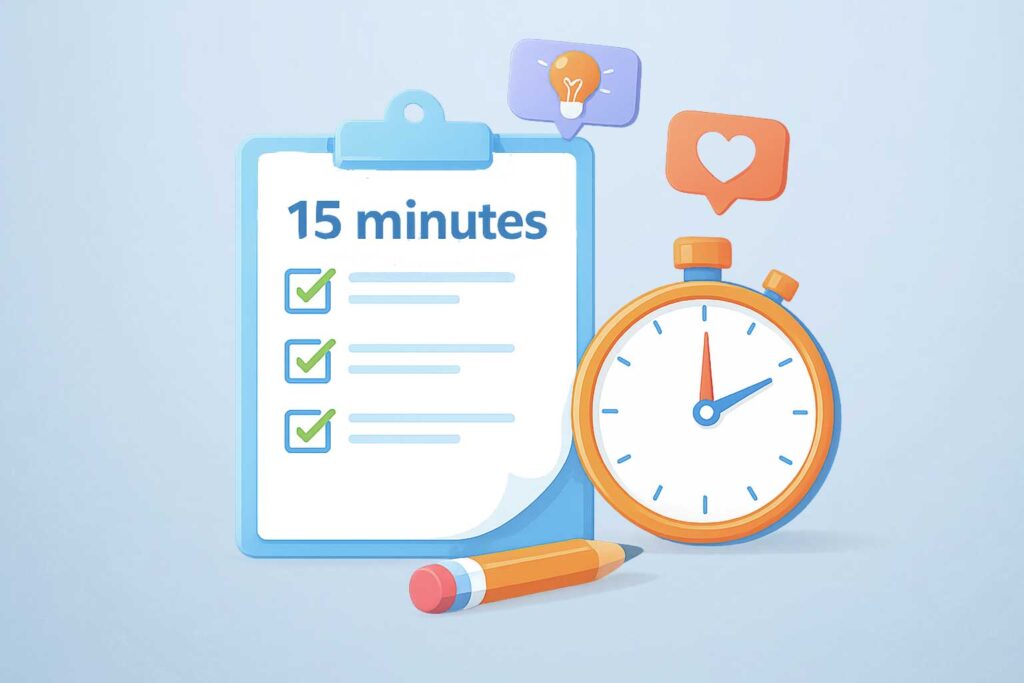
In this article, I will give you a “DIY” 15-minute daily marketing routine that I designed specifically for busy business owners who need to grow their online presence without burnout.
In the online world, consistency beats intensity. However, consistency without strategy is just noise. To make your marketing effective in limited time, you first need to understand who you are talking to and where they are hanging out.
Audience vs. Community: Why It Matters
Before you spend a single minute on marketing, you must understand the difference between building an audience and building a community.
An Audience is a group of people who listen to you. It is a one-way street. Think of a TV commercial; the brand speaks, and the people watch.
A Community is a group of people who talk to you and to each other about you. This is a two-way street.
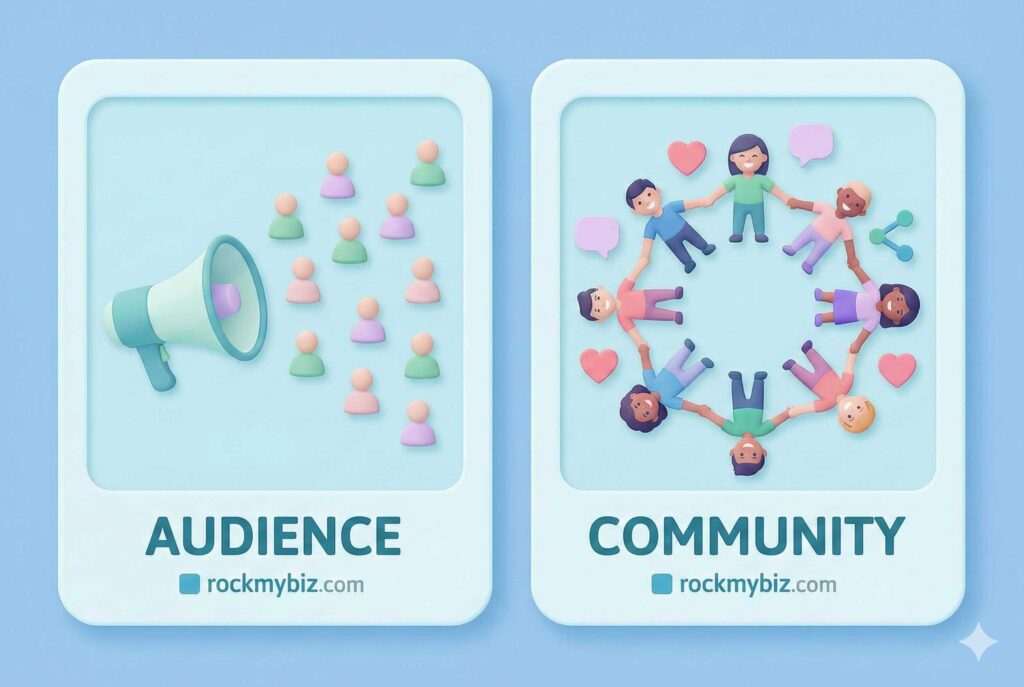
Why this matters for your budget: An audience requires constant advertising spend to keep their attention.
A community provides organic growth. When you build a community, your customers become your marketers. They tag their friends, they leave reviews, and they defend your brand.
For a small business with limited time, your goal is not to get a million “likes” (audience); it is to get 50 loyal locals who engage with you (community).
What Users Expect: The “Small Business” Advantage
Many small business owners feel intimidated by big brands. You might look at a corporation’s polished Instagram feed and feel your photos aren’t “professional” enough.
Here is the good news: Consumers do not want you to be a big corporation.
According to recent consumer data, the expectations for small businesses are vastly different, and easier to meet, than those for big brands.
🔶 Big Brand Expectations:
When a customer interacts with a massive company like Nike or Starbucks, their psychology is different. They see a logo, not a person.
Perfection: Users expect big brands to be flawless. Because customers know these companies have million-dollar budgets, a blurry photo or a typo looks like incompetence or laziness. They demand high-production video, studio lighting, and perfectly curated feeds.
Speed (Instant Gratification): When a customer tweets at an airline or uses a bank’s chat feature, they expect an immediate response, usually within minutes. They expect 24/7 availability via chatbots or call centers because they know the resources are there.
Uniformity: The “McDonald’s Effect.” Customers go to big brands for predictability. They want the experience, the packaging, and the product to be exactly the same every single time, regardless of location.
Small Business Expectations:
When a customer interacts with you, they aren’t looking for a logo. They are looking for a neighbour.
Authenticity (Imperfection is Okay): Users don’t just tolerate imperfection from small businesses; they often prefer it. A shaky video of you laughing while packing an order feels “real.” It proves a human is doing the work, not a machine. If your hair is messy in a Story, it makes you relatable, not unprofessional.
Connection: Customers want to know their money has an impact. They understand that buying from you supports a local family, pays for dance lessons, or keeps Main Street alive. They are looking for a relationship, not just a transaction. They want to feel like an “insider” in your journey.
Passion & Expertise: Big brands hire employees; small businesses are run by experts. Customers expect you to care deeply about your craft. They want to see your excitement about a new ingredient or your pride in a finished project. That passion is contagious and is something a corporate marketing team can rarely fake.
The Takeaway: You don’t need a production studio. You just need to be human. Imperfection is actually your greatest asset because it signals “realness”.
 You might also like: A Beginners Guide for Small Business Owners to Boost their Local SEO
Who is a “Small Business Owner”? Is that you?
When we say “small business owner”, we aren’t talking about a CEO with a board of directors. We are talking about the local heroes who wear every hat, from CEO to janitor.
In the eyes of search engines (and your community), you fit this definition if you are:
The Local Service Provider: Plumbers, electricians, and HVAC techs who need to dominate “near me” searches.
The Brick-and-Mortar Retailer: Boutique owners, florists, and gift shops that rely on foot traffic.
The Hospitality Host: Coffee shops, bakeries, and food trucks where “vibe” is everything.
The Solopreneur: Freelancers, consultants, and real estate agents building a personal brand.
If you see yourself in this list, you have a distinct advantage: Agility. While big corporations take days to approve a single tweet, you can snap a photo of your daily special or a finished project and publish it instantly.
🔶 🔶 Speed is your superpower 🔶 🔶
Platform Breakdown: Where Should You Spend Your 15 Minutes?
Not all platforms are created equal. By platforms, I mean channels where your brand has a presence apart from your website, such as Google Business Profile, Instagram, TikTok, Facebook and so on. To maximise your 15 minutes, you need to match your content to the user’s mindset on that platform.
1. Google Business Profile
The “I Need it Now” Crowd
User Mindset: High intent. These people are looking to buy or visit right now.
Expectation: Accurate hours, photos of the vibe/products, and recent reviews.
Businesses with photos receive 42% more requests for directions on Google Maps than those without.
2. Instagram
The “Visual Inspiration” Crowd
User Mindset: Discovery and aesthetics. They are scrolling to be entertained or inspired.
Expectation: High-quality visuals (Stories can be raw; Feed should be nicer) and “Behind the Scenes” content.
90% of users follow a business on Instagram. They want to hear from you, provided it’s visually engaging.
3. TikTok
The “Raw Entertainment” Crowd
User Mindset: Entertainment and education.
Expectation: Unfiltered, funny, or educational videos. Low production value is actually preferred here.
TikTok users are 1.5x more likely to immediately go out and buy something they discovered on the platform compared to other social networks.
4. Facebook
The “Community News” Crowd
User Mindset: Connecting with friends, family, and local groups.
Expectation: Information, events, and community discussions.
Facebook Groups remain one of the most powerful tools for local businesses to generate word-of-mouth.
Now that you understand the strategy (Authenticity + Community), here is how to execute it efficiently. Grab your morning coffee and set a timer.
Who is a “Small Business Owner”?
When we say “small business owner,” we aren’t talking about a CEO with a board of directors. We are talking about the local heroes who wear every hat—from CEO to janitor.
In the eyes of search engines (and your community), you fit this definition if you are:
The Local Service Provider: Plumbers, electricians, landscapers, and HVAC technicians who need to dominate “near me” searches.
The Brick-and-Mortar Retailer: Boutique clothing shop owners, florists, and gift shop managers who need foot traffic.
The Hospitality Host: Coffee shop owners, bakery managers, restaurant owners, and food truck operators.
The Wellness Professional: Hair stylists, barbers, local beauty salons, yoga instructors, and personal trainers.
The Solopreneur & Freelancer: Graphic designers, photographers, real estate agents, and consultants building a personal brand.
If you see yourself in this list, you have a distinct advantage: Agility. While big corporations take months to approve a single tweet, you can snap a photo of your daily special or a finished project and publish it instantly. This speed is your superpower.
Platform Breakdown: Where Should You Spend Your 15 Minutes?
Not all platforms are created equal. To maximize your 15 minutes, you need to match your content to the user’s mindset on that app.
1. Google Business Profile
The “I Need it Now” Crowd
User Mindset: High intent. These people are looking to buy or visit right now.
Expectation: Accurate hours, photos of the vibe/products, and recent reviews.
Businesses with photos receive 42% more requests for directions on Google Maps than those without.
2. Instagram
The “Visual Inspiration” Crowd
User Mindset: Discovery and aesthetics. They are scrolling to be entertained or inspired.
Expectation: High-quality visuals (Stories can be raw; Feed should be nicer) and “Behind the Scenes” content.
90% of users follow a business on Instagram. They want to hear from you, provided it’s visually engaging.
3. TikTok
The “Raw Entertainment” Crowd
User Mindset: Entertainment and education.
Expectation: Unfiltered, funny, or educational videos. Low production value is actually preferred here.
TikTok users are 1.5x more likely to immediately go out and buy something they discovered on the platform compared to other social networks.
4. Facebook
The “Community News” Crowd
User Mindset: Connecting with friends, family, and local groups.
Expectation: Information, events, and community discussions.
Facebook Groups remain one of the most powerful tools for local businesses to generate word-of-mouth.
Now that you understand the strategy (Authenticity + Community), here is how to execute it efficiently. Grab your morning coffee and set a timer.
The 15-Minute Daily Marketing Checklist
Minutes 0–5: Engagement - Wake Up Your Algorithms
Don’t start by posting. Start by listening. Social platforms prioritize accounts that are social, not just broadcasting machines.
Reply to comments: Check your Facebook, Instagram, or LinkedIn notifications. Reply to every single comment from the last 24 hours. A simple “Thanks, [Name]!” goes a long way.
Comment on 3 local posts: Find 3 posts from other local businesses, community groups, or partners in your area. Leave a genuine comment (not just an emoji). This puts your business name in front of their local followers.
Check your DMs: diverse quick answers to potential customers. Speed of response is a huge trust signal.
Minutes 5–10: Local Visibility - Google & Reviews
For local businesses, your Google Business Profile (formerly Google My Business) is more important than your website.
Check for new reviews: Did you get a new review on Google or Yelp? Respond immediately.
If it’s positive: “Thank you so much for the kind words!”
If it’s negative: “I’m sorry to hear this. Please contact us directly so we can make it right.”
💡 Pro Tip: Don’t know what to say? Writer’s block can waste your 15 minutes fast. If you are staring at a negative review and don’t know how to respond professionally, use the Rockmybiz Review Booster. It instantly generates perfect, empathetic responses for you. Try the Review Booster for Free
Upload 1 photo: Google loves fresh content. Snap a quick photo of a new product, your team working, or even just your shop front in the morning light. Upload it directly to your Google Business Profile.
Tip: You don’t need a professional photographer. Authentic, raw photos often perform better because they look real.
Minutes 10–15: The "Micro-Content" Post
Writer’s block is the enemy of speed. If you get to the last 5 minutes of your routine and don’t know what to post, pick one of these “evergreen” formats:
The “One Question” Answer:
Concept: Think of a question a customer asked you this week.
Post: Record a 30-second video answering it. “People always ask me how often to water these plants…”
The “Local Love” Shoutout:
Concept: Community building.
Post: Share a photo of your lunch from a neighboring deli or a product from a nearby shop. Tag them. They will likely share it, exposing you to their audience.
The “Work in Progress” (WIP):
Concept: Authenticity.
Post: A messy desk, a half-painted wall, or ingredients on a counter. Caption: “Making magic happen for a client today.”
 PRO TIP: Check out our Blog Topic Ideas Generator to help you come up with ideas for your next blog post and our Content Generator to create content that actually sounds like you
Tools to Keep You on Track
You don’t need expensive software to do this. Simple, free tools work best for this approach:
Google Maps App: Use this to manage your Business Profile and upload photos directly from your phone.
Meta Business Suite: Allows you to answer Facebook and Instagram messages in one inbox.
Your Phone’s Timer: Seriously. When the 15 minutes are up, stop. This prevents marketing from taking over your day.
Summary: Small Actions, Big Compound Effect
Marketing isn’t about one viral post; it’s about showing up when others quit.
If you stick to this 15-minute routine, here is what your marketing “math” looks like at the end of just one month:
150+ meaningful interactions with local customers (Minutes 0–5).
30 fresh photos on Google, signaling to search engines that you are active (Minutes 5–10).
30 pieces of content telling your brand story (Minutes 10–15).
You can’t achieve that with a sporadic “marketing blitz” once a month. You achieve it by showing up for 15 minutes a day.
Your Next Step: Don’t wait for Monday. Set your timer for 15 minutes tomorrow morning and start with Step 1: Reply to your comments.
Posted 30 times on your social media.
All of that for just 15 minutes a day. Start tomorrow morning, and watch your local visibility grow.
FAQ – Quick answers on questions on your marketing routine
Is 15 minutes really enough to market a small business?
Yes, if you are consistent. The goal isn’t to create a viral campaign every day; it’s to signal to customers and search algorithms that you are active. By spending 15 minutes daily on high-impact tasks, like replying to reviews and posting to your Google Business Profile, you build momentum that outperforms sporadic, hours-long marketing binges.
Which social media platform is best for local businesses?
There is no single “best” platform, but for local visibility, Google Business Profile is non-negotiable. It drives actual foot traffic and calls. For social engagement, choose Instagram if your business is visual (food, beauty, retail) or Facebook if your community relies on local groups and events. Don’t try to be everywhere; master one platform first.
What should I post when I have "nothing" to post?
When you run out of polished ideas, switch to “documenting.” Share a photo of your workspace, a close-up of a tool you use, or a “thank you” to a recent customer. This type of authentic content often performs better than polished ads because it builds trust.
Does this routine help with SEO?
Absolutely. Google prioritizes businesses that are active. By regularly uploading photos to your profile and responding to reviews (Minutes 5–10 of the routine), you send strong signals to Google that your business is alive and relevant, which is a key factor in ranking higher in Local SEO results.
What if I miss a day of marketing?
Don’t panic. Marketing is a marathon, not a sprint. If you miss a day, just pick it up again tomorrow. The key is to avoid “ghosting” your audience for weeks at a time, which can hurt your algorithm reach.